Two families of trout bait
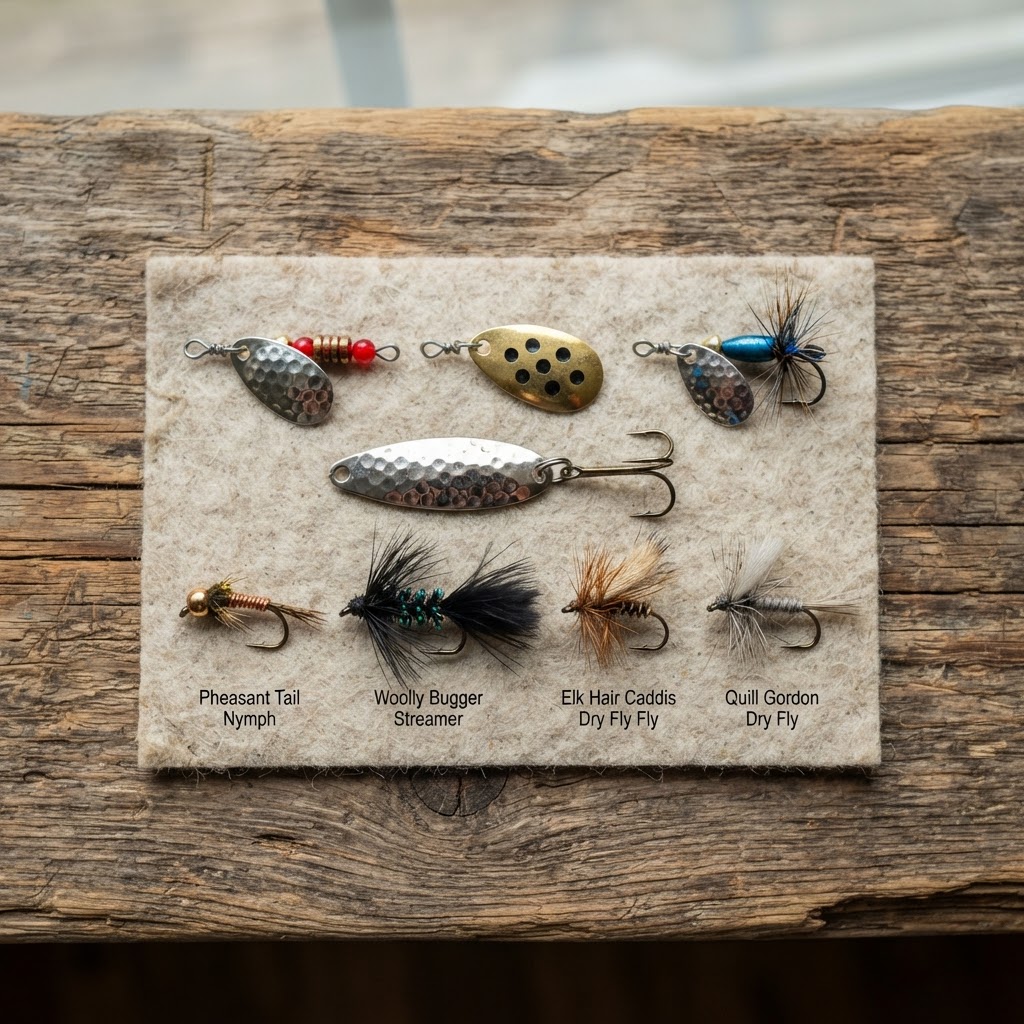
Trout eat insects, small fish, crustaceans and whatever else the water offers. Anglers imitate that with two broad families: flies that imitate insects and other tiny prey, and hardware — spinners, spoons and small crankbaits — that imitates a baitfish or triggers a reaction. Neither is better. Each solves a different problem.
The choice usually comes down to water type and depth. Moving water with a visible hatch calls for a fly. Big, windy water or deep lake structure calls for hardware. When you cannot decide, start with what you can fish well.
Flies: matching the drift
The first question in fly fishing is not which fly, it is where the fly is drifting. Trout hold in current and let food come to them, so a fly that drifts naturally at the right depth beats a better-looking fly that drags.
- Nymphs imitate underwater insects. A bead-head nymph dead-drifted under an indicator is the most productive beginner fly approach on streams. Fish it near the bottom, and adjust the indicator depth until you stop snagging and start getting takes.
- Dry flies imitate insects on the surface. They are the most enjoyable way to fish and the most condition-dependent: you need rising fish, or at least a hatch in progress.
- Streamers imitate baitfish and larger prey. Strip them across current, swing them through pools, or cast them to banks and retrieve. This is how you hunt bigger trout.
- Soft-hackles and wet flies sit just under the surface and can be swung through current with very little skill required.
A small box is enough to start: two or three nymphs in different weights, a couple of dry flies that match local hatches, and two streamers in light and dark. Ask a local shop what hatches are happening — that is genuinely useful local information, not a sales pitch.
Hardware: covering water
Spinners, spoons and small minnow baits are the practical tools for lakes, big rivers and windy days.
- Inline spinners in small sizes are the classic stream and pond lure. Cast across and slightly upstream so the lure swings down through the holding water, then retrieve just fast enough that the blade turns.
- Spoons cast further and sink faster, which matters on lakes and deep pools. A fluttering spoon on a slow lift-and-drop is deadly on lake trout and rainbows.
- Small crankbaits and minnow plugs imitate baitfish and can be trolled or cast along weed edges and drop-offs.
- Jigs with a soft plastic work in deep, cold water when fish will not chase.
Color matters less than depth and speed. Pick a light lure for bright conditions and clear water, a dark or gold lure for stained water and low light, then spend your attention on the retrieve.
Reading the water to choose
On a stream, watch for the obvious holding water: the foam line, the seam behind a boulder, the deep slot under a cut bank, the tail of a pool. If fish are rising, a dry fly is the obvious first choice. If nothing is showing on the surface, fish a nymph at the depth where the current slows.
On a lake, the choice is depth. Trout near the surface in cool water will take a dry fly, a small spinner or a shallow-running plug. Trout holding deep need a sinking line, a heavy spoon, or a jig fished slowly. Locate the depth first, then choose the tool that reaches it.
Presentation details that get bites
- Light line. Fluorocarbon tippet or 4- to 6-pound spinning line. Trout in clear water see heavy line.
- Quiet approach. Cast from further back, keep a low profile, and avoid shadows crossing the water.
- Drift over retrieve. On moving water, a natural drift with no drag catches more trout than a retrieved lure.
- Vary the speed before the color. If two passes get nothing, change depth or speed, not lure color.
- Hooks. Barbless hooks make release easier and are required on many trout waters.
Bait, where it is allowed
Worms, salmon eggs, shrimp and dough baits catch trout effectively, and on stocked ponds they are often the fastest route to a fish. But bait is also where regulations bite hardest: many trout waters are artificial-lures-only or fly-only, and bait bans exist to protect fish that are released. Bait is also swallowed deeper, which makes safe release harder.
If bait is allowed, use a single hook, set it promptly, and keep what you catch within the limit. If it is not allowed, respect that — it is the reason the fishing is still good.
Handling for release
Wet your hands, keep the fish in or close to the water, support it under the belly rather than hanging it by the jaw, and use forceps to back the hook out. If a fish is deeply hooked, cut the line rather than digging. Keep air exposure to a few seconds, and never hold a trout by the gill plate.
Regulations to confirm
Trout regulations are the most detailed in most states: seasons, size limits, bag limits, gear restrictions, bait bans, and separate permits or stamps. Waters are often listed individually, and some are closed entirely outside a season. Wild and native trout populations frequently have stricter rules than stocked waters.
Check your state fish and wildlife agency's current rules, then the page or signage for the specific water. This is not a formality: it is the difference between a legal trip and a citation.
Key takeaways
- Flies win on moving water and rising fish; hardware wins on lakes, wind and depth.
- Depth and drift matter more than pattern or color.
- Nymphs fished near the bottom are the most reliable beginner fly approach.
- Light line, a quiet approach and long casts are worth more than a new lure.
- Trout waters carry the strictest gear and bait rules — check them before you fish.
Sources and further reading
Technique in this guide is general angling practice, not a research finding. The links above are where the rules and safety facts come from.
Keep reading
FINN'S FISHING TIP
Take one idea from this page onto the water. One you will actually use beats five you will forget.